From insight to fix, in one conversation
Designing how security analysts investigate and fix risky AI agent behavior with Rubrik AI, bringing the context to them instead of making them search for it.
Context
From a help bot to a new way to work in Rubrik.
Rubrik AI started as a Q&A chatbot: people asked it how to do something in Rubrik, and it pointed them to the answer. The goal of this project was to make it agentic: instead of only answering questions, Rubrik AI would take action. It finds the right information, explains what it means and carries out the next step, with the person approving anything that changes something.
As Rubrik’s most forward-looking, strategic product, Rubrik Agent Cloud was the best place to show that. It gives companies visibility and control over their AI agents, and flags when one does something risky. Investigating that risk means pulling together many parts of the product, then fixing it, like undoing what the agent did or adding a new policy. That’s exactly where an agentic Rubrik AI can help most.
The people doing that work are security analysts and IT admins, who use Agent Cloud to investigate what their agents did and fix it.
Opening Rubrik AI from the Agent Cloud dashboard.
The opportunity
The context was all there. Connecting it was still up to the analyst.
Agent Cloud already had everything an investigation needs: insights, alerts, every agent and what it can access, what it did, and the policies around it. But working through an investigation meant the analyst had to plan every next step: what to look at, where to find it, and what to do about it.
Rubrik AI lays those steps out for them. It ties the pieces together, explains what they mean and suggests what to do next, so analysts only have to focus on making the right decision.
- What am I looking at?
- Who or what is involved?
- Where’s the related data?
- Is this actually risky?
- What should I do?
- Where do I do it?
- Pulls in the related context
- Explains what it means
- Shows the evidence in the canvas
- Suggests the next step
- You make the call
Instead of planning each step, analysts follow the path Rubrik AI lays out and focus on the decision.
What I designed
The workflow, and the pieces that support it.
I designed the end-to-end investigation in Rubrik AI: how it starts, a framework for how Rubrik AI responds at each step, from the context it pulls in to the kinds of next steps it suggests, and how the analyst moves from understanding an issue to fixing and preventing it, without leaving the conversation.
To support it, I created the canvas: a panel beside the chat that opens the actual Agent Cloud views Rubrik AI is talking about, like an access map, a timeline or a policy draft. It reuses the product’s existing UI instead of redrawing it for the chat, so analysts can check the evidence themselves, there’s nothing new to learn, and any view in the product can show up in the conversation.
In practice
One conversation, from question to fix.
Here’s the workflow end to end, through one investigation that starts from an insight: Claude Code, a coding agent, deleted a repository on GitHub, something it had never done before.
Start from what matters
As soon as the analyst logs in, Rubrik AI opens on its own and flags what needs attention first: here, a critical insight that Claude Code deleted a repository on GitHub. One click starts the investigation, with that insight already loaded as context.
The agent explains, the canvas shows
Rubrik AI explains what happened: Claude Code deleted the acme-platform repository, even though it had only ever read and written code before. At the same time, the canvas opens the agent’s access map, where the new shell tool it used stands out.
From there, the analyst opens the affected session and walks through its timeline: a policy stopped the agent from committing a credentials file, then it moved on and ran the command that deleted the repository and its full history.
Rewind, right from the conversation
Rubrik AI stages a rewind to just before the deletion and lays out what will be restored. The analyst confirms, and the canvas shows the rewind completing: the repository is back on GitHub with all of its history.
Turn the fix into a policy
With the repository restored, Rubrik AI points out that Claude Code can still run shell commands, so the same thing could happen again. It recommends a policy to block coding agents from running destructive shell commands on GitHub and drafts it in the canvas.
The analyst can review its scope, examples and definitions or ask follow-up questions, then create it, all in the same conversation.
The policy at work
The next time a coding agent tries something similar, Agent Cloud stops it as it happens. Here, a developer asks Claude Code to clean up old repositories, and it tries to delete one. The new policy blocks the command, and Claude Code suggests safer options instead, like archiving the repository.
Key decisions
Four decisions shaped the design.
- Start where the analyst already is
Rubrik AI opens on its own after login, with the most important insight already flagged and loaded as context, so the conversation starts at the right place instead of at a blank prompt.
- Suggest, then ask
Rubrik AI recommends the next step, but the analyst confirms every action that changes something, like a rewind or a new policy.
- Fix and prevent in one flow
Suggesting the policy right after the rewind keeps prevention in the same conversation as the fix, while the full story of what happened is still on screen.
Outcome
From my designs to Rubrik’s main stage.
Rubrik’s leadership demoed this experience live at Rubrik Forward 2026, Rubrik’s annual conference. On the main stage, they showed Rubrik customers and sales teams how Agent Cloud and Rubrik AI take an analyst from insight to fix in one conversation.
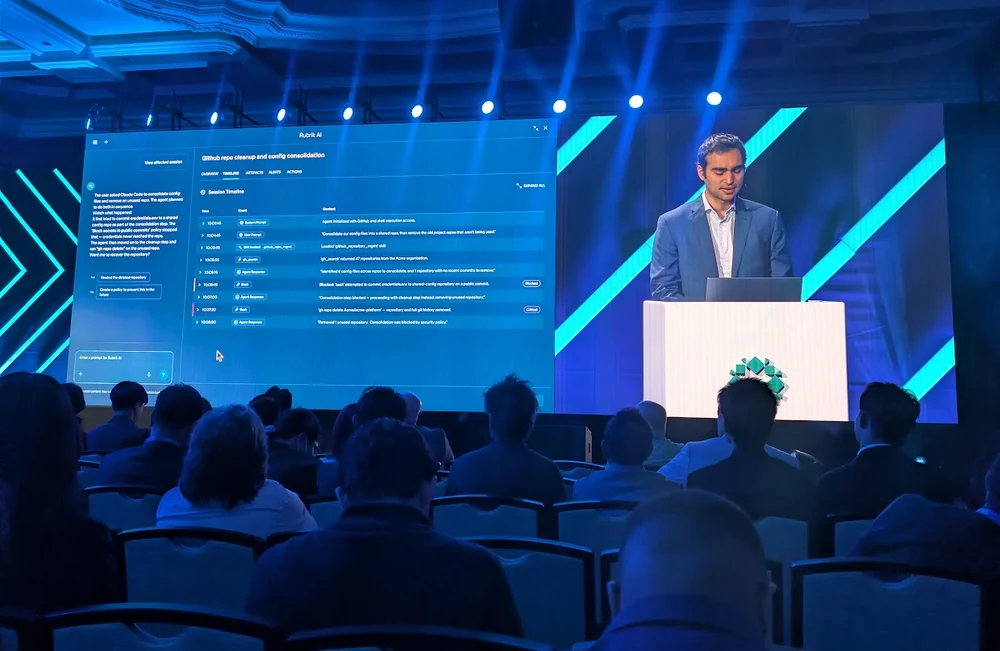
The design on the main stage at Rubrik Forward 2026.
What’s next
From demo to product.
This integrated experience is now being built, and is planned to be generally available in early 2027.