Design highlights · Rubrik Security Cloud
A unified home for Settings
Redesigning the settings experience so it scales with an expanding set of apps and stays easy to navigate.
Context
Rubrik Security Cloud launched with one flagship app. Then it grew.
The platform started with data protection and recovery, then added apps for threat monitoring and investigation and for data security posture. Settings lived in a dropdown in the top navigation, listing every option.
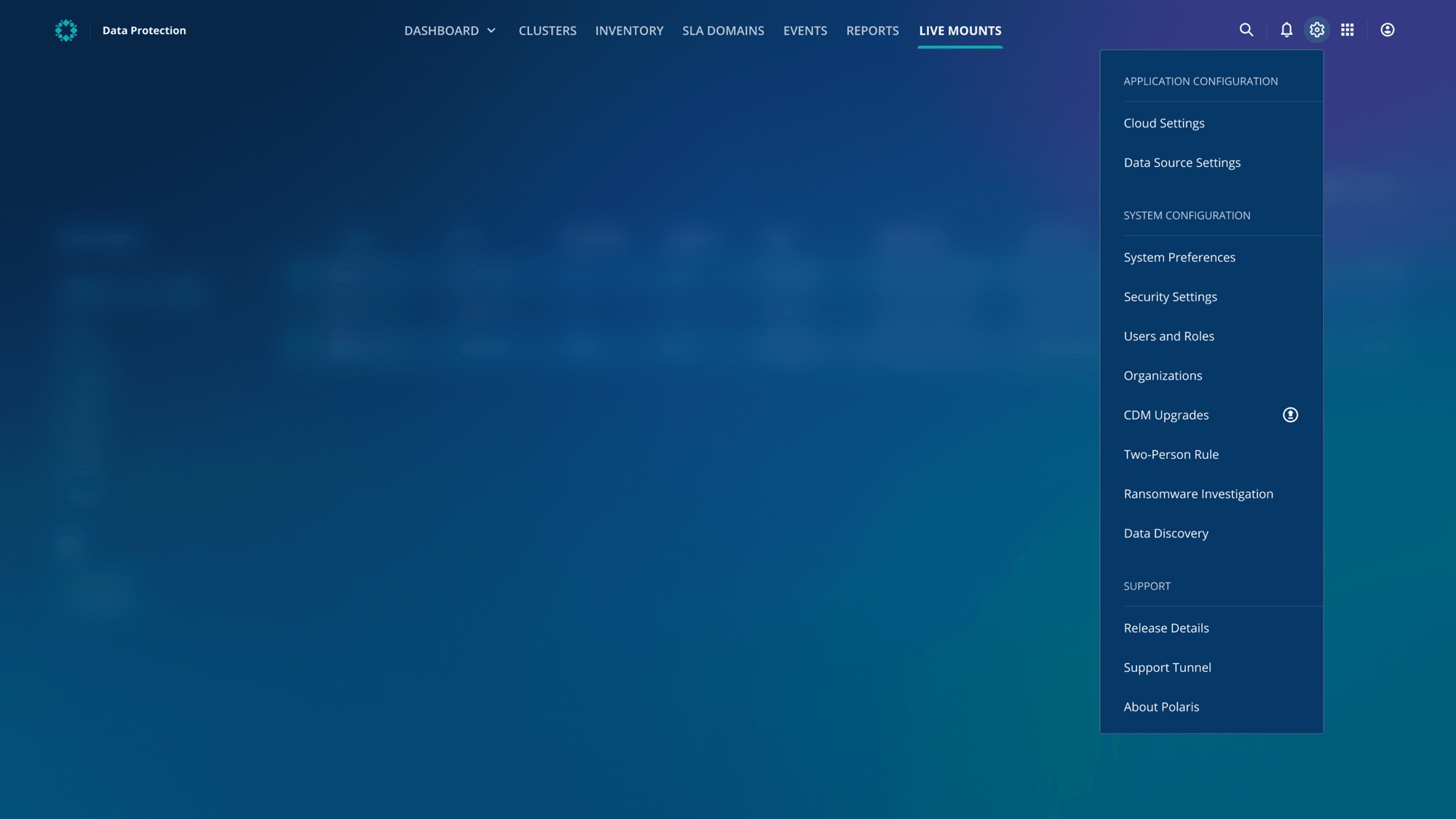
The original Settings dropdown.
Problem
The settings interface had three main issues.
- Scalability
Every new app added more settings to the dropdown, making it cluttered and harder to find and manage configurations.
- Consistency and clarity
Settings looked the same in every app, implying they were app-specific when they were actually global.
- Misleading categories
The grouping wasn’t intuitive, so customers struggled to find the settings they needed.
Solution
A comprehensive redesign of how Settings is reached, organized and used.
Centralized access
Settings moved into the App Switcher, alongside every other Rubrik app. That makes it clear Settings is a global control, separate from individual applications.
Intuitive navigation, better information architecture
The new Settings Room has a searchable side navigation, with categories redefined through user research and extensive card sorting, so settings are logically organized and easy to discover.
Users can switch between settings and sub-settings without losing context, and collapse the side panel to focus while configuring.
Workflow integration
Back links take users who drill into Settings from another Rubrik app straight back to where they were, keeping their journey uninterrupted.
Outcome
Customers called the new interface easy and intuitive — and the back links were a particular favorite.
The redesign resolved the scalability and information architecture issues and made managing settings feel integrated into users’ daily work.
It wasn’t without challenges. Moving every setting into the new side navigation required extensive refactoring — far more than first expected — and close collaboration with engineering to get there.